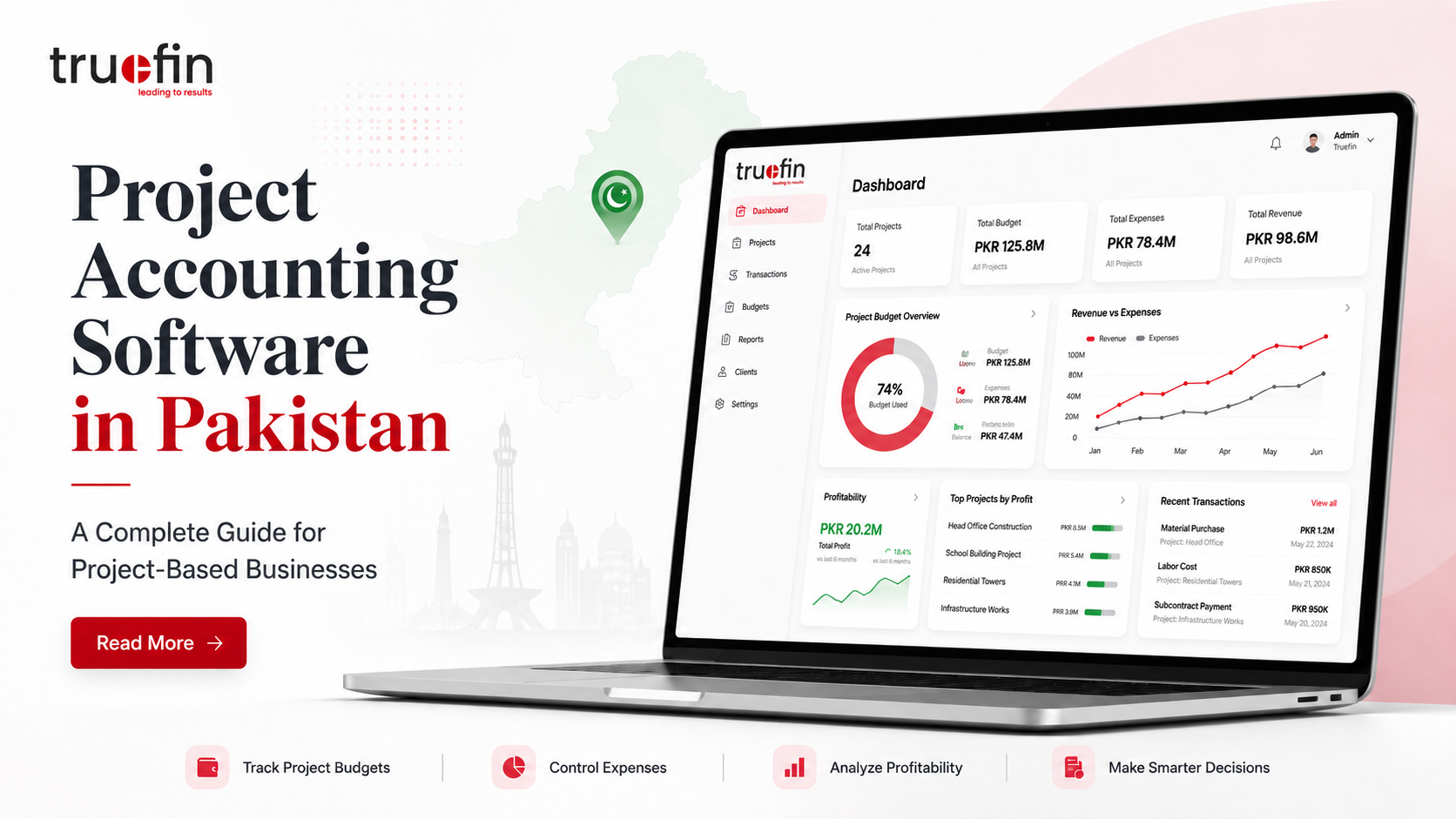
Project accounting software in Pakistan can help project-based businesses manage budgets, expenses, revenue and profitability more effectively.
A company may need to understand not only its overall income and expenses, but also the financial performance of each individual project.
For example, a construction company may want to know whether a specific project is profitable. A consultancy may need to compare project revenue with employee costs. An NGO may need to track donor funding and project-specific expenses. A software company may need to understand how much time and money has been spent on a client implementation.
This is where project accounting software can become valuable.
Project accounting software helps organizations record financial transactions while assigning those transactions to specific projects.
For businesses operating in Pakistan, this can provide better visibility over project budgets, expenses, revenue, profitability and financial reporting.
In this guide, we explain what project accounting is, how project accounting software works and which features businesses should consider when choosing a system.
What Is Project Accounting?
Project accounting is the process of tracking financial activity at the individual project level.
Traditional accounting provides information about the financial position of the entire organization, while project accounting provides more detailed information about individual projects.
For example, a company may have total monthly expenses of PKR 5 million. That figure alone may not explain which projects are profitable and which projects are consuming more resources than expected.
Project accounting allows businesses to assign costs and revenue to specific projects.
A project may include:
- Revenue
- Direct expenses
- Employee costs
- Supplier costs
- Materials
- Travel
- Equipment
- Overheads
- Taxes
- Other project-related expenses
By tracking these items separately, management can better understand the financial performance of each project.
Why Businesses Need Project Accounting Software in Pakistan
Many organizations initially manage projects using spreadsheets.
One spreadsheet may contain the project budget. Another may contain supplier expenses. A separate file may track employee costs, while the accounting system records financial transactions independently.
This creates a problem because project information and accounting information become disconnected.
Management may need to manually reconcile multiple spreadsheets before understanding the actual financial position of a project.
Project accounting software creates a more structured process.
Financial transactions can be recorded in the accounting system and linked directly to the relevant project.
This allows management to review project-level information without maintaining a separate accounting process for every project.
Key Features of Project Accounting Software
Project Budget Management
Every project normally starts with an expected budget.
The budget may include employee costs, supplier costs, materials, travel, equipment, administrative expenses and other operating costs.
Project accounting software should allow businesses to create project budgets and compare them with actual expenses.
This helps management identify overspending before the project is completed.
For example, if a project has a budget of PKR 10 million and actual expenses have already reached PKR 9 million while only 60% of the work is complete, management can investigate the issue immediately.
Project Expense Tracking
Expenses should be assigned directly to the project that generated them.
This may include:
- Supplier invoices
- Employee reimbursements
- Travel expenses
- Materials
- Fuel
- Equipment
- Professional services
- Other project costs
Without project-level expense tracking, organizations may struggle to understand the true cost of individual projects.
Revenue Tracking
PProject-based businesses also need to track revenue at the individual project level.
Revenue may come from:
- Project invoices
- Milestone payments
- Retainer agreements
- Service contracts
- Donor funding
- Grants
Project accounting software should allow revenue to be associated with the relevant project.
This makes it easier to compare project income with project costs.
Budget vs Actual Reporting
One of the most useful project accounting reports is the budget-versus-actual report.
This compares the planned project budget with the amount actually spent.
For example:
- Project Budget: PKR 5,000,000
- Actual Expenses: PKR 4,200,000
- Remaining Budget: PKR 800,000
This helps management identify projects that are approaching or exceeding their budgets
Project Profitability
Project profitability shows whether a project is generating enough revenue to cover its costs.
A project may generate high revenue but still produce a low profit if expenses are too high.
Project accounting software can help calculate:
- Project revenue
- Direct project expenses
- Employee costs
- Supplier costs
- Gross profit
- Net profit
- Profit margin
Monitoring profitability helps businesses understand which projects are performing well.
Project Accounting vs Traditional Accounting
Traditional accounting focuses on the financial position of the organization as a whole.
It answers questions such as:
- What is the company’s total revenue?
- What are the total expenses?
- What is the current bank balance?
- What is the overall profit?
- What are customer receivables?
- What are supplier payables?
Project accounting focuses on individual projects.
It answers questions such as:
- How much revenue has Project A generated?
- How much has Project B spent?
- Which projects are over budget?
- Which projects are most profitable?
- How much budget remains?
- Which expenses belong to each project?
Both approaches are important.
The most effective accounting system connects project-level financial information with the organization’s general accounting records.
Who Can Benefit From Project Accounting Software?
Construction Companies
Construction businesses often manage several projects at the same time.
Each project may have different budgets, suppliers, materials, labor costs, equipment costs and revenue arrangements.
Project accounting can help management monitor these costs separately.
Consulting Firms
Consulting companies may need to measure profitability for individual client engagements.
Project accounting can help compare client revenue with employee costs, travel, subcontractors and other project expenses.
NGOs and Non-Profit Organizations
NGOs frequently operate multiple donor-funded projects.
Each project may have a separate budget and reporting requirement.
Project accounting can help maintain project-level financial records while keeping the organization’s overall accounting records centralized.
Software and IT Companies
Software companies may manage development projects, implementations and client engagements.
Project accounting can help track project costs and profitability.
Professional Services Businesses
Engineering firms, architects, marketing agencies and other professional service companies can also benefit from project-based financial reporting.
Cloud Project Accounting Software
Cloud project accounting software allows authorized users to access financial information through the internet.
This can be useful for organizations with multiple offices, remote teams or project locations.
Authorized users may be able to review:
- Project budgets
- Expenses
- Revenue
- Supplier transactions
- Customer invoices
- Profitability
- Financial reports
Cloud systems can also help keep project information centralized.
How TrueFin Supports Project Accounting
TrueFin can help project-based organizations maintain accounting information in a centralized environment.
Instead of maintaining separate spreadsheets for project budgets, expenses and financial reports, businesses can use a structured accounting system to connect project-level activity with overall financial records.
TrueFin can support visibility over areas such as:
- Project budgets
- Project expenses
- Revenue
- Customer transactions
- Supplier transactions
- Budget utilization
- Financial reporting
This can help management better understand how individual projects are performing.
Project Accounting Best Practices
Organizations should combine suitable software with clear financial processes.
Useful practices include:
- Create a unique project code for every project
- Define budgets before work begins
- Record expenses promptly
- Assign transactions to the correct project
- Review budget-versus-actual reports regularly
- Monitor project profitability
- Reconcile project information with accounting records
- Define clear user responsibilities
- Use role-based access
- Maintain supporting documentation
Consistent processes improve the quality of project financial information.
Frequently Asked Questions
What is project accounting software?
Project accounting software helps organizations track revenue, expenses, budgets and profitability at the individual project level.
What is the difference between project accounting and normal accounting?
Normal accounting focuses on the overall organization, while project accounting focuses on individual projects.
Can project accounting software track project budgets?
Yes. A suitable system can allow businesses to define project budgets and compare them with actual spending.
Can project accounting software track project profitability?
Yes. It can help compare project revenue with project costs and calculate profit margins.
Is project accounting useful for NGOs?
Yes. NGOs can use project accounting to track donor-funded projects, budgets and project expenses.
Can small businesses use project accounting software?
Yes. Small businesses that manage multiple projects or client engagements can benefit from project-level financial tracking.
Conclusion
Project-based organizations need more than a general view of their financial performance.
Management also needs to understand how individual projects are performing.
Project accounting software can provide better visibility over project budgets, expenses, revenue and profitability.
For businesses in Pakistan that currently rely on spreadsheets or disconnected project records, moving toward a centralized accounting system can improve financial control and make project reporting more reliable.
The right solution should support both project-level reporting and the organization’s overall accounting requirements.
For organizations looking to improve project-level financial management, TrueFin can provide a centralized accounting environment designed to support structured financial records and project-based reporting.