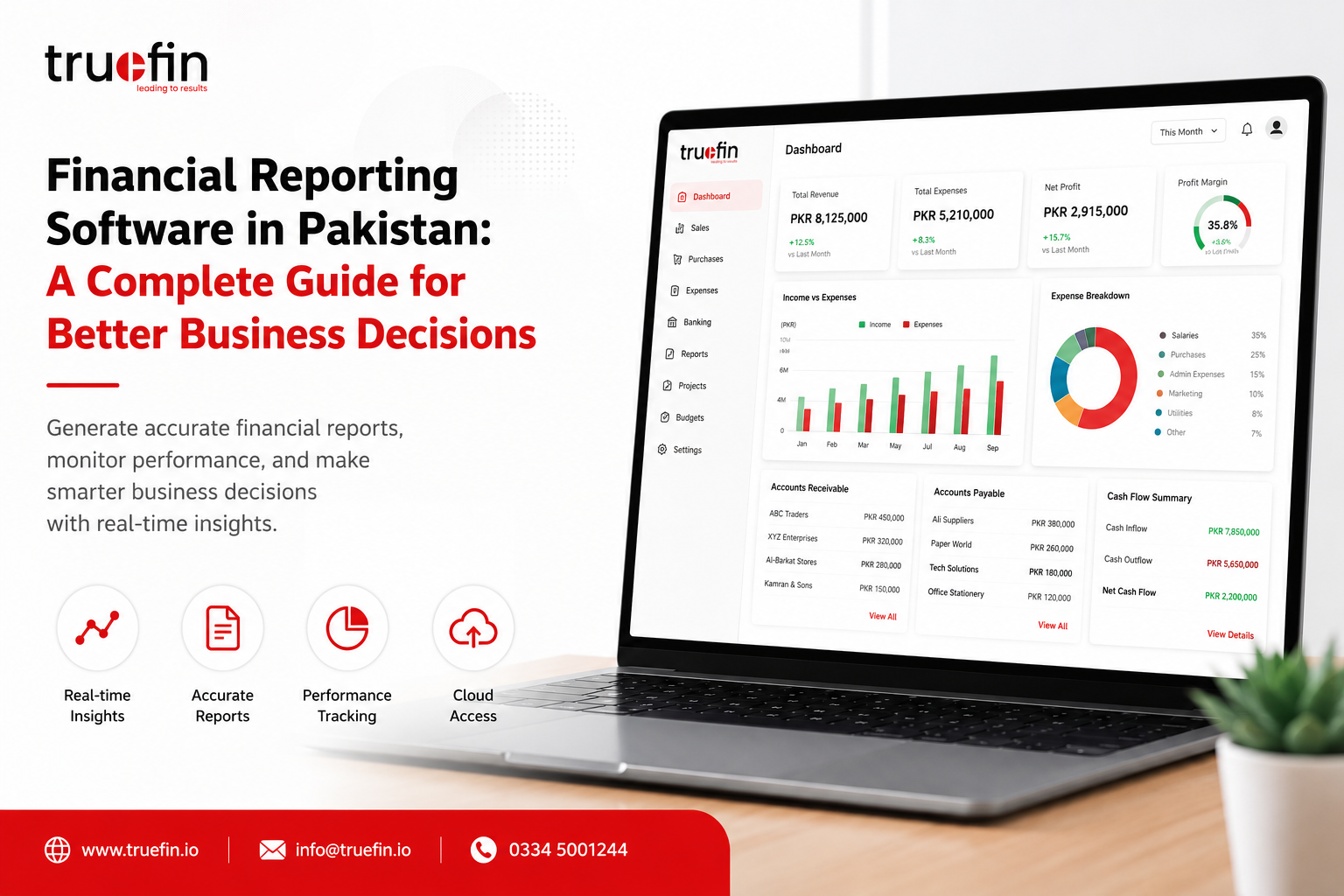
Businesses need accurate financial information to understand how they are performing.
Recording transactions is important, but financial data becomes much more useful when it can be converted into clear reports.
Financial reporting software in Pakistan can help organizations transform accounting information into reports that management can use for planning, analysis and decision-making.
Instead of manually combining spreadsheets or reviewing individual transactions, businesses can use financial reports to understand revenue, expenses, profitability, cash flow, receivables, payables and other important financial information.
For growing organizations, reliable financial reporting can improve visibility and help management respond more quickly to financial problems.
In this guide, we explain what financial reporting software is, which reports businesses commonly need and how organizations can improve their financial reporting processes.
What Is Financial Reporting?
Financial reporting is the process of preparing and presenting financial information about an organization.
These reports help management, business owners and other authorized users understand the financial position and performance of the business.
Common financial reports include:
- Profit and Loss Statement
- Balance Sheet
- Cash Flow Statement
- Trial Balance
- General Ledger
- Accounts Receivable Report
- Accounts Payable Report
- Budget vs Actual Report
- Project Profitability Report
- Expense Reports
Each report provides a different view of the organization’s financial activity.
Together, they provide management with a clearer understanding of financial performance.
Why Businesses Need Financial Reporting Software in Pakistan
Many businesses initially rely on spreadsheets for financial reporting.
Accounting data may be exported from one system and manually reorganized in Excel before management can review it.
This process can create several problems:
- Manual calculation errors
- Duplicate information
- Delayed reporting
- Different versions of the same report
- Difficulty tracing figures back to transactions
- Limited real-time visibility
- Time-consuming reconciliation
Financial reporting software can reduce this manual work by generating reports directly from accounting records.
When transactions are recorded correctly, reports can be updated using the same financial data.
This creates a more consistent and reliable reporting process.
Key Financial Reports Businesses Should Monitor
Profit and Loss Statement
The Profit and Loss Statement shows the income and expenses of a business during a specific period.
It can help management understand whether the business is generating a profit or loss.
Typical information may include:
- Sales revenue
- Service revenue
- Cost of sales
- Salaries
- Rent
- Utilities
- Administrative expenses
- Other income
- Other expenses
- Net profit or loss
Regular review of the Profit and Loss Statement can help management identify changes in profitability.
Balance Sheet
The Balance Sheet provides information about the financial position of a business at a specific point in time.
It normally includes:
- Assets
- Liabilities
- Equity
Assets may include cash, bank balances, customer receivables, inventory and equipment.
Liabilities may include supplier payables, loans and other obligations.
The Balance Sheet helps management understand what the organization owns and what it owes.
Cash Flow Reporting
A profitable business can still experience cash flow problems.
Cash flow reporting helps management understand how money is entering and leaving the organization.
Cash inflows may include:
- Customer payments
- Project receipts
- Investment
- Financing
Cash outflows may include:
- Supplier payments
- Salaries
- Rent
- Utilities
- Taxes
- Operating expenses
Monitoring cash flow can help organizations plan upcoming payments and reduce liquidity problems.
Accounts Receivable Reporting
Accounts receivable reports show amounts customers owe to the business.
Management may need to review:
- Outstanding invoices
- Customer balances
- Overdue invoices
- Aging of receivables
- Payment history
This information can help businesses improve collection processes and manage cash flow.
Accounts Payable Reporting
Accounts payable reports provide visibility over amounts owed to suppliers.
These reports can help management understand:
- Outstanding supplier invoices
- Upcoming payments
- Overdue balances
- Supplier transaction history
This makes it easier to plan supplier payments and maintain better financial control.
Budget vs Actual Reporting
Budget-versus-actual reporting compares planned spending with actual financial activity.
For example:
- Approved Budget: PKR 8,000,000
- Actual Expenses: PKR 6,300,000
- Remaining Budget: PKR 1,700,000
This information helps management understand whether spending is within the approved budget.
Organizations using budget management software can benefit from connecting budget information directly with financial reporting.
Project Financial Reporting
Project-based organizations may need reports for individual projects.
These reports may include:
- Project revenue
- Project expenses
- Budget utilization
- Supplier costs
- Employee costs
- Profitability
- Remaining budget
Using project accounting software alongside financial reporting can provide management with both organization-level and project-level visibility.
Financial Reporting Software vs Spreadsheet Reporting
Spreadsheets are flexible and widely used.
For small organizations, spreadsheets may initially be sufficient for basic reports.
However, as transaction volumes increase, manual reporting becomes more difficult.
Financial information may exist in multiple files, and staff may need to manually update formulas every reporting period.
This can increase the risk of mistakes.
Financial reporting software provides a more structured process because reports are generated from accounting records.
Instead of manually rebuilding reports each month, businesses can use consistent report formats based on current financial data.
Benefits of Financial Reporting Software
Faster Reporting
Automated reports can reduce the time required to prepare monthly or management reports.
Finance teams can spend less time combining spreadsheets and more time reviewing the financial information.
Better Accuracy
When reports are generated from accounting transactions, manual data entry and spreadsheet calculation errors can be reduced.
Improved Financial Visibility
Management can review important financial information without examining individual transactions.
This makes it easier to identify trends and unusual activity.
Better Decision-Making
Financial reports provide information that management can use when making decisions about:
- Spending
- Hiring
- Pricing
- Investments
- Projects
- Supplier payments
- Business expansion
More Consistent Reporting
Standard report formats can help ensure that financial information is presented consistently across different reporting periods.
Who Can Benefit From Financial Reporting Software?
Small and Medium-Sized Businesses
SMEs can use financial reports to understand profitability, expenses, receivables and cash flow.
As businesses grow, financial reporting becomes increasingly important for planning.
NGOs and Non-Profit Organizations
NGOs may need financial reports for management, donors and individual projects.
Reports may include:
- Project expenditure
- Budget utilization
- Donor funding
- Expense summaries
- Financial position
Construction and Project-Based Businesses
Project-based organizations may need both company-wide and project-specific reports.
Financial reporting software can help management understand which projects are performing well and which require attention.
Professional Services Firms
Consultancies, software companies, engineering firms and other professional service organizations can use reports to understand revenue, project costs and profitability.
Growing Organizations
As organizations add more departments, customers, suppliers and projects, management may need more structured reporting.
Centralized financial reporting can provide better visibility across the organization.
Cloud Financial Reporting Software
Cloud financial reporting software allows authorized users to access financial reports through the internet.
This can be useful for organizations operating across multiple offices or locations.
Authorized users may be able to review:
- Financial statements
- Customer balances
- Supplier balances
- Project reports
- Budget reports
- Expense information
from different locations.
Cloud-based systems can also help organizations maintain centralized financial information.
How TrueFin Supports Financial Reporting
TrueFin can help organizations maintain accounting records and generate structured financial information from a centralized system.
Financial transactions recorded within the system can be used to support reporting across areas such as:
- Revenue
- Expenses
- Customer balances
- Supplier balances
- Budgets
- Projects
- Financial performance
This can reduce dependence on disconnected spreadsheets and manual report preparation.
TrueFin can also help organizations connect financial reporting with other accounting activities, including budgeting and project accounting.
For businesses evaluating financial reporting software in Pakistan, it is important to consider reporting requirements, transaction volume, organizational structure and internal financial processes.
Financial Reporting Best Practices
Organizations should combine suitable software with strong financial processes.
Useful practices include:
- Record transactions promptly
- Use a consistent chart of accounts
- Reconcile bank accounts regularly
- Review customer and supplier balances
- Close accounting periods consistently
- Review unusual transactions
- Compare actual results with budgets
- Maintain project-level records where required
- Restrict financial information based on user responsibilities
- Review management reports regularly
Reliable reports depend on accurate accounting information.
Frequently Asked Questions
What is financial reporting software?
Financial reporting software helps organizations generate financial reports using accounting information recorded in the system.
What are the main financial reports?
Common reports include the Profit and Loss Statement, Balance Sheet, Cash Flow Statement, Trial Balance, receivable reports and payable reports.
Can financial reporting software show budget vs actual results?
Yes. A suitable system can compare approved budgets with actual financial activity.
Can financial reporting software track project performance?
Yes. When financial transactions are linked to projects, businesses can generate project-level reports for revenue, expenses and profitability.
Is financial reporting software useful for small businesses?
Yes. Small businesses can use financial reports to understand profitability, cash flow, customer balances and expenses.
Can NGOs use financial reporting software?
Yes. NGOs can use financial reporting for organizational and donor-funded project reporting.
What is the benefit of cloud financial reporting software?
Cloud systems can allow authorized users to access financial information from different locations while keeping records centralized.
Conclusion
Accurate financial reporting is essential for effective business management.
Accounting transactions provide the underlying data, but reports turn that information into something management can understand and use.
Financial reporting software in Pakistan can help businesses improve reporting accuracy, reduce manual spreadsheet work and gain better visibility over financial performance.
For growing organizations, centralized financial reporting can support better planning, budgeting and decision-making.
The right solution should provide reliable financial reports while connecting them with the organization’s accounting, project and budget information.
For businesses looking to improve financial visibility, TrueFin can provide a centralized accounting environment designed to support structured financial reporting.